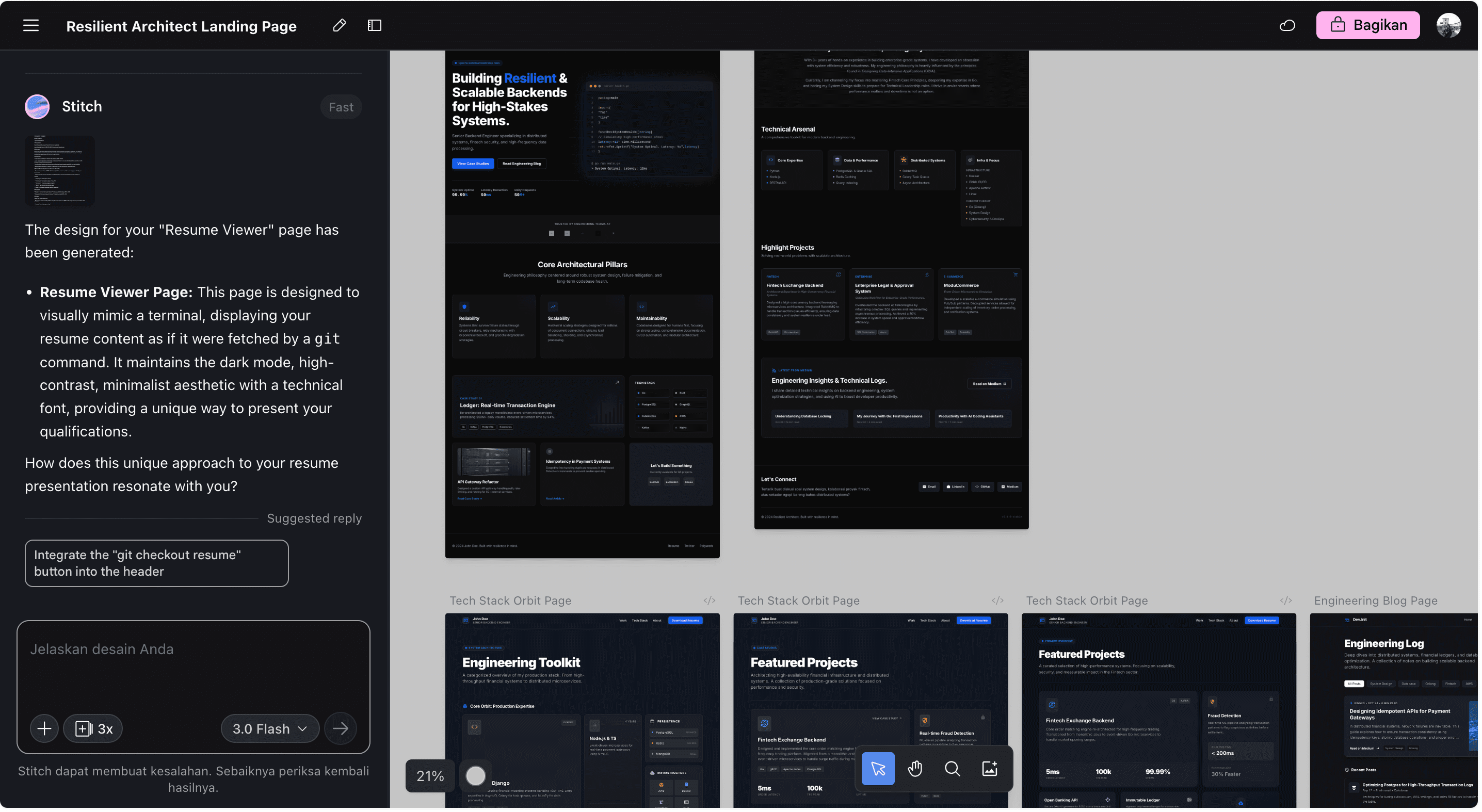
What usually takes weeks, this time my personal website was finished in just two days.
As a backend developer, I’m comfortable working with logic, data, and APIs. But once I step into frontend territory, the challenge isn’t simply writing HTML or CSS.
The real bottleneck often appears much earlier.
It’s about deciding the layout, structuring the content, and figuring out what kind of user experience the site should deliver.
Without a clear visual direction, development slows down—not because the code is hard, but because there are too many decisions to make upfront.
What I did was actually quite simple.
I used AI not to replace the development process, but to reduce ambiguity at the beginning.
I started with Google Stitch to explore website designs through prompts.
Not to find a “perfect” design, but to get a visual sense of the layout, page structure, and content flow.
Once the design took shape, coding became significantly clearer.
The design acted as a mental model—I knew which components to build and how everything should connect.
During the development phase, I used Google Antigravity to accelerate implementation.
From project setup to building several components and drafting initial content, the process moved much faster—without sacrificing quality.
As a result, within roughly two days, my personal website was already functional and usable, even though the content will continue to evolve.
This experience reinforced something I strongly believe:
AI isn’t about replacing skills—it’s about reducing friction.
What gets accelerated isn’t just coding, but decision-making: design choices, structural decisions, and implementation paths.
In this context, speed becomes a competitive advantage.
Not because we rush, but because we can reach a testable, usable, improvable version much faster.
That said, it’s important to remember one thing:
AI never fully holds the context.
Judgment, taste, and responsibility as an engineer remain firmly in our hands.
In the end, this isn’t about which tools we use.
It’s about how we build products today—how quickly we move, learn, and adapt without compromising quality.
Tools will keep changing.
But the ability to reduce friction, maintain clarity, and stay accountable for the final outcome is a skill that will always remain relevant.
Share this article
Found this useful? Share it with your network.