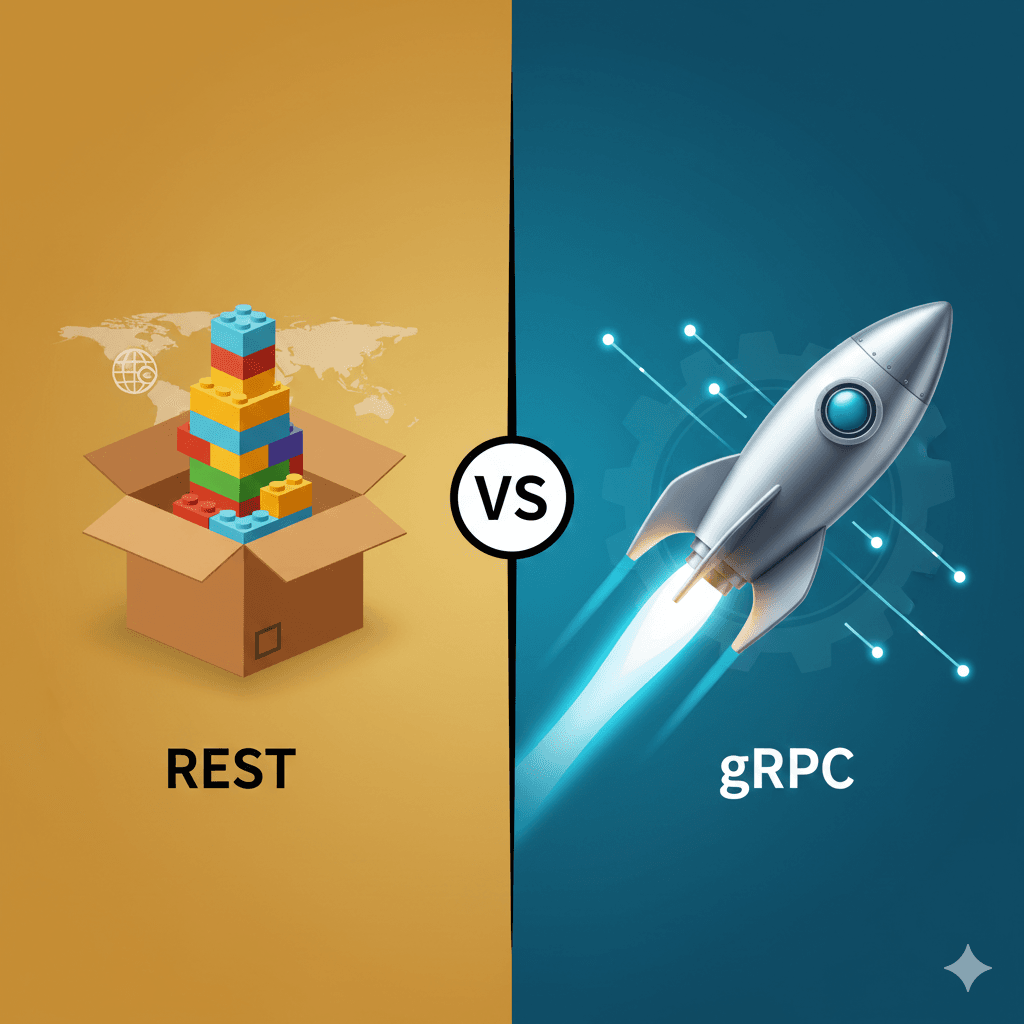
Imagine this: Your microservices architecture is live, and everything seems perfect. Your team is comfortable with REST APIs, JSON is easy to debug, and development is fast. But as traffic scales, the cracks begin to show.
Latency creeps up. The overhead of parsing massive JSON payloads starts choking your servers. CPU usage spikes, and under heavy load, your services begin to timeout. You’ve hit the "REST Wall."
Google faced this exact challenge. When systems reach a certain scale, traditional REST starts to show its limits. They needed a more efficient way for internal services to talk—and that’s how gRPC was born.
The impact is real:
- Netflix slashed internal latency by 70% after migrating key services to gRPC.
- Google reduced bandwidth consumption by 30% using Protocol Buffers (Protobuf) instead of JSON.
But does this mean REST is dead? Absolutely not. Every tool has its place.
The real questions are: Why is gRPC so much faster in specific scenarios? What are the fundamental trade-offs? And most importantly, when should you migrate to gRPC, and when should you stick with REST?
In this article, we’ll break down the fundamental differences, explore the strengths and limitations of both, and help you make the right architectural decision for your system.
Let’s start by dissecting the core concepts: REST vs. RPC.
Understanding the Core: REST vs. RPC
Before we dive into gRPC, we need to distinguish between two massive communication paradigms: REST and RPC. While they both move data, their philosophies are worlds apart.
1. REST: The Vending Machine (Resource-Oriented)
Imagine you’re standing in front of a vending machine. Each item (a soda, a snack, a sandwich) is a Resource. To get what you want, you interact with a specific slot (the URL) and use a standard action (the HTTP Method):
- You request the slot
/drinks/coke(GET). - The machine doesn't care who you are or what you did five minutes ago (Stateless).
- You interact with nouns (the objects) in the machine.
Key Philosophy: Everything is a "thing" (Resource).
2. RPC: The Personal Assistant (Action-Oriented)
Now, imagine you have a Personal Assistant. You don't walk to a machine; you just give a direct command. You don't care where the data is stored; you just want the task done.
Instead of looking for a "coke" resource, you tell your assistant:
getMeADrink(type="coke", cold=true)
You are calling a Procedure (a function). You’re telling the system to DO something. It feels like the assistant is standing right next to you, even though they might be in a different room (Remote).
Key Philosophy: Everything is a "verb" (Action/Function).
The Origins and Background of gRPC
gRPC is not just “a cool protocol built by Google.”It emerged from real-world pain points at massive system scale. To understand why gRPC exists, we need to look briefly at its origins.
Inside Google, long before gRPC was introduced publicly, internal services communicated using a proprietary RPC system called Stubby. Stubby became the backbone of service-to-service communication across Google’s highly distributed infrastructure — involving thousands of services constantly talking to each other.
However, Stubby was never designed for the outside world. It was tightly coupled to Google’s internal infrastructure and not suitable for open, cross-platform use. As Google’s systems matured, they realized the need for a modern, open-source RPC framework — one that could be used by anyone, across different languages and environments, while retaining the performance and reliability of their internal systems.
This led to the creation of gRPC (Google Remote Procedure Call) around 2015. While gRPC inherited core ideas from Stubby, it was rebuilt from the ground up to serve a broader ecosystem beyond Google.
The Problems gRPC Was Designed to Solve
Efficient Communication Between Microservices
As applications evolved into microservices architectures, inter-service communication became a critical bottleneck. REST, which worked well at smaller scales, began to show its limitations — verbose payloads, higher parsing overhead, and increasing latency.
gRPC addressed this by using Protocol Buffers, a compact binary format that significantly reduces payload size and improves serialization performance, making service-to-service communication faster and more efficient.
Cross-Language Interoperability
In real-world systems, it’s common for different services to be written in different programming languages — for example, Go for one service, Python for another, and Java for a third.
gRPC provides automatic code generation from a shared schema, allowing services written in different languages to communicate seamlessly without manual protocol handling or custom serialization logic.
Native Support for Streaming Data
Unlike traditional REST APIs, gRPC supports bi-directional streaming out of the box. This allows clients and servers to continuously exchange data over a single connection, rather than relying on repeated request-response cycles.
This capability makes gRPC well-suited for use cases such as:
- Real-time messaging
- IoT data ingestion
- Streaming data pipelines
- Online gaming and live collaboration systems
Overcoming REST Limitations in Low-Latency Environments
In environments where low latency and high throughput are essential — such as trading systems, large-scale backend platforms, or real-time sensor networks — REST can struggle to meet performance requirements.
gRPC was designed specifically for these scenarios, prioritizing:
- Low latency
- Efficient network utilization
- High-performance communication under load
Google was not alone in facing these challenges. As distributed systems became more complex, many organizations began searching for a modern RPC framework that was lightweight, flexible, and production-ready. gRPC emerged as a response to these shared needs, helping drive a broader evolution in the RPC ecosystem.
From here, we can explore how RPC has evolved over time — from early approaches like XML-RPC to modern solutions such as gRPC — and examine alternative technologies that address similar challenges in different ways.
Understanding gRPC More Deeply
After exploring the long journey and many variations of RPC, it’s time to take a closer look at one of the most important players in modern service-to-service communication: gRPC.
gRPC (Google Remote Procedure Call) is an open-source framework originally developed by Google and now maintained by the Cloud Native Computing Foundation (CNCF). It is designed to enable fast, efficient, and scalable communication between services—addressing the real challenges of modern systems such as microservices architectures, IoT platforms, and real-time applications.
To understand why gRPC is fundamentally different—and often more suitable for these environments—we need to look at its three core building blocks.
1. Protocol Buffers (Protobuf): The Contract Between Client and Server
Unlike REST, which commonly relies on JSON or XML, gRPC uses Protocol Buffers (Protobuf) as its data format and interface definition language (IDL).
Think of Protobuf as a formal contract between the client and the server. Before any communication happens, both sides agree on:
- what functions (RPC methods) are available, and
- what the structure of the request and response data looks like.
Because this contract is defined upfront, there is no need for runtime guessing, loose parsing, or schema ambiguity—problems that are common in JSON-based APIs.
Protobuf uses a binary format, which makes payloads significantly smaller and serialization/deserialization much faster compared to JSON. The result is lower latency, reduced bandwidth usage, and more predictable performance, especially at scale.
2. HTTP/2 as the Transport Layer
gRPC is built on top of HTTP/2, not HTTP/1.1 like most REST APIs. This choice is not about using a “newer version,” but about unlocking capabilities that are essential for high-performance, service-to-service communication.
Some of the most important features enabled by HTTP/2 include:
Multiplexing
In HTTP/1.1, a single connection processes requests sequentially, which often leads to blocking. HTTP/2 allows multiple requests and responses to be sent concurrently over a single TCP connection.
Why it matters: This drastically reduces latency and connection overhead, making gRPC well-suited for microservices environments where services communicate frequently and in parallel.
Bi-directional Streaming
gRPC fully leverages HTTP/2’s full-duplex communication, allowing both client and server to send messages simultaneously over an open connection.
Why it matters: This enables efficient real-time use cases such as live updates, event streams, IoT telemetry, and interactive systems—without repeatedly opening and closing connections.
Header Compression
HTTP/2 applies HPACK compression to request and response headers, which significantly reduces overhead in chatty systems.
Why it matters: In microservices architectures, headers can become a hidden cost. Compressing them improves throughput and reduces network usage without sacrificing metadata.
3. Channels, Stubs, and Services
These three components form the core interaction model of gRPC and explain why calling a remote service can feel like calling a local function.
Channel
A channel is a long-lived communication path opened by the client to the server over HTTP/2. It can handle many concurrent RPC calls without repeatedly creating new connections.
Impact: Lower latency, better resource utilization, and more stable performance under high load.
Stub
A stub acts as a local proxy for a remote service. When the client calls a method on the stub, it looks like a normal function call—but under the hood, the stub:
- serializes the request using Protobuf,
- sends it over the channel,
- waits for the response, and
- deserializes the result.
Impact: The client doesn’t need to care about network logic or server implementation details—only the contract.
Service
A service is a collection of RPC methods defined in a .proto file. From this definition, both client and server generate their respective code.
The service acts as the public interface of the server, ensuring that:
- only explicitly defined methods are accessible, and
- both sides stay in sync as the system evolves.
Bringing It All Together
These components: Protobuf, HTTP/2, and the channel–stub–service model work together to make gRPC: fast and efficient, strongly typed and consistent, language-agnostic, and well-suited for large-scale, distributed systems. However, technical strength does not automatically mean universal suitability.
Despite its performance and elegance, gRPC comes with real-world trade-offs and practical limitations that must be understood before adopting it broadly in production systems.
That’s where the discussion gets interesting—and where we’ll go next.
Challenges and Limitations of gRPC
Despite its high performance and advanced features, gRPC is not a universal solution. Like any technology, it comes with trade-offs that must be carefully evaluated before adopting it in real-world systems.
Understanding these limitations is critical—especially to avoid overengineering or introducing unnecessary complexity.
Steeper Learning Curve
Compared to REST, which can be explored instantly using tools like curl or Postman, gRPC requires a deeper upfront understanding. Developers need to be familiar with Protocol Buffers, code generation workflows, and a more structured project setup.
For teams that are not accustomed to strongly typed contracts or automated build pipelines, this can become an initial barrier. The productivity gains of gRPC often appear later—after the learning curve has been overcome.
Limited Browser Support
Native browser environments do not support gRPC directly. This limitation stems from the fact that HTTP/2 streaming is not accessible from standard browser JavaScript APIs.
While solutions like gRPC-Web exist, they come with constraints:
- limited support for streaming features, and
- the need for additional infrastructure such as a proxy (e.g., Envoy).
As a result, gRPC adoption for frontend-heavy applications is far less seamless than REST, which can be consumed universally via plain HTTP.
More Complex Debugging and Observability
Because gRPC uses a binary protocol, requests and responses are not human-readable by default. This makes debugging more involved compared to REST, where responses can be inspected directly in a browser or with simple CLI tools.
Ecosystem and Community Maturity
REST has been the dominant API style for over a decade. As a result, it benefits from:
- a massive ecosystem,
- extensive documentation, and
- highly mature tooling across virtually all platforms and languages.
While the gRPC ecosystem is growing rapidly, it is not yet as comprehensive. Some programming languages, frameworks, or infrastructure tools still offer partial or inconsistent support for advanced gRPC features.
When Should You Use gRPC vs REST?
After discussing performance, trade-offs, and limitations, we arrive at the most practical question:
In what situations should you choose gRPC—and when is REST still the better option?
There is no absolute answer. The right choice depends heavily on the context of your system, its consumers, and its operational constraints.
When gRPC Is the Right Choice
gRPC shines in backend-to-backend communication, especially in microservices architectures operating within the same data center or controlled network environment. In these scenarios, performance, efficiency, and cross-language support become top priorities.
Typical use cases where gRPC fits best:
- Inter-service Communication in Microservices: gRPC’s lightweight protocol and binary serialization make it ideal for high-frequency communication between services. It works consistently across multiple programming languages with minimal overhead.
- Low-latency, Real-time Systems: Applications such as chat systems, multiplayer games, live analytics, or event-driven pipelines benefit from gRPC’s HTTP/2 foundation and efficient Protobuf encoding, which significantly reduce latency.
- Polyglot Environments: If different services are written in different languages—Go, Java, Python, or others—gRPC’s code generation ensures seamless communication without manual data format negotiation.
- Streaming Data Workloads: gRPC natively supports client streaming, server streaming, and bidirectional streaming. This makes it well-suited for IoT platforms, telemetry systems, video streaming, and continuous data flows.
When REST Remains the Better Option
For systems that are public-facing or browser-driven, REST often remains the more pragmatic choice. Its maturity, simplicity, and universal compatibility make it hard to replace in these contexts.
Situations where REST is usually more appropriate:
- Public APIs: If your API will be consumed by external developers, REST is more familiar and easier to explore. Developers can test it instantly using browsers, Postman, or curl without additional tooling.
- Direct Browser-to-Server Communication: Because browsers do not natively support gRPC (without workarounds like gRPC-Web), REST remains the default for frontend applications.
- When Simplicity and Accessibility Matter: JSON is human-readable, easy to debug, and ideal for rapid onboarding. REST minimizes friction when development speed and clarity are more important than raw performance.
- Heavy Use of Caching and CDNs: REST integrates naturally with HTTP caching mechanisms and CDN infrastructure. For content-heavy or read-dominated workloads, this can significantly improve scalability and cost efficiency.
Final Takeaway
There is no universally superior choice between gRPC and REST. Each serves different needs:
- gRPC excels at internal, high-performance, service-to-service communication.
- REST excels at public, browser-accessible, and simplicity-driven APIs.
The correct decision depends on who consumes your service, how it is deployed, and what constraints you are optimizing for.
To close this discussion, the next step is to distill these insights into a practical decision guide. One that helps you confidently choose the right approach in real production systems.
Selection Guide
At this point, we’ve covered a lot about gRPC and REST—from their origins and design philosophy to performance characteristics and real-world use cases. Still, it’s very likely you’re thinking:
“So… which one should I actually use for my project?”
To avoid overthinking and to make this decision more practical, here’s a simple decision tree you can use as a quick guide when choosing between gRPC and REST:
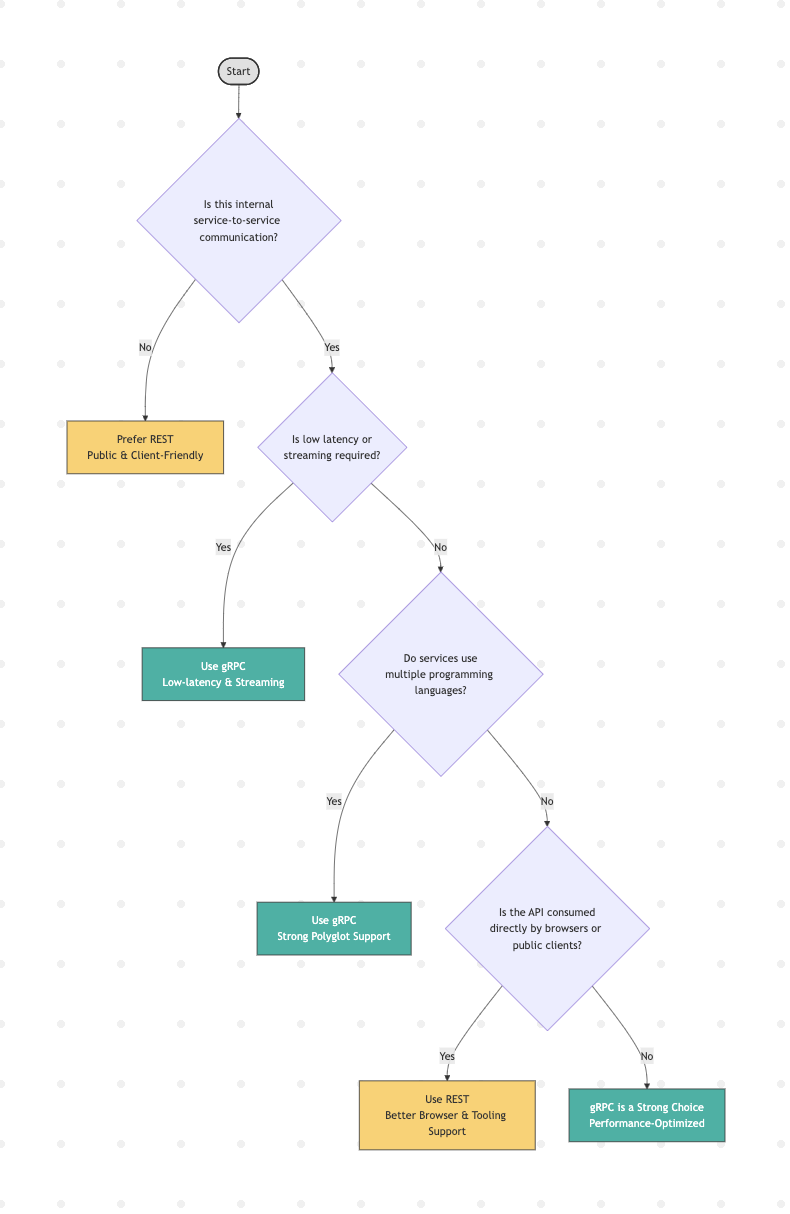
Closing Thoughts
In modern software systems, the demand for scalability, reliability, and efficiency continues to grow. gRPC was not created to replace REST entirely, but to serve as a more suitable alternative in specific contexts. As system architectures evolve, inter-service communication is increasingly moving toward solutions that are high-performance and streaming-oriented—and gRPC fits naturally into that direction.
Ultimately, as developers, our responsibility is not to be loyal to a single technology, but to understand when and why we choose it. Hopefully, after reading this article, you feel more confident in selecting the right tool for the right job—based on real constraints, not trends or hype.
Share this article
Found this useful? Share it with your network.